
Weather, trail conditions and seasonality considerations when choosing dates for a Kilimanjaro climb.
When Is The Best Time To Climb Mount Kilimanjaro?
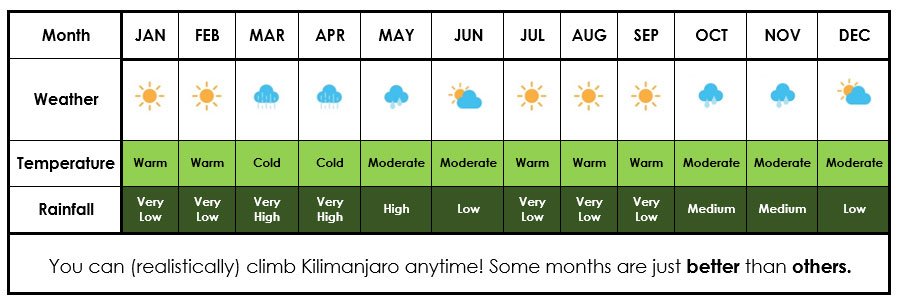
The best thing about visiting Kilimanjaro during the high season is that the mountain is generally dry. However, you should not be surprised if it rains on you this time especially within the rain-forest and moorland zones as the mountain receives rain all year round. But generally the rain in this season is extremely minimal. So because it is dry, you will stay dry and comfortable and the trails will be dry and much easier to climb. Therefore, with the discomfort of being wet and trembling cold eliminated, you will have a better opportunity to acclimatize well. Furthermore, during the dry season, the skies are clear and the views are good. Looking at the negative side of visit the Kilimanjaro during this time, there are so many climbers on the mountain at this time, so you will not feel like you are up on a remote very big mountain. But so people, this works to their advantage as they get a chance to socialize with other tourist groups especially while at the overnight camps. Nonetheless, the large crowds experienced during the dry season are not a setback for main especially when the think about the good weather they will experience up the mountain during this time of the year.
Well, the thought of bring up the mountain all by yourself is another factor that draws some tourists to trekking during the low rainy season. During this time of the year, there are hardly any people on the mountain, and it’s no surprise when you are alone at a campsite. It is extremely quiet and isolated up the mountain. Another thing, despite the fact that it rains frequently during this time of the year, the rains in this season normally come in the afternoon, when most of the trekking has been completed. According the climbing schedule on Mount Kilimanjaro, climbers normally do most of trek in the morning which implies that you can actually minimize the amount of time spent on the route as it rains. The good thing about the rainy season is that you will be able to summit the mountain when the peak is covered with snow a thing that best displays the beauty and uniqueness of this mountain, and the most breathtaking sights on the Kilimanjaro are in the morning right
- Home
- Mt.Trekking
Kilimanjaro, Month By Month
Are you looking for a month wise analysis for choosing the right time in Climbing Mount Kilimanjaro? We are here to solve your query:
With breathtaking clear skies in the mornings and evenings, this period is rightly considered the Best Season To Climb Kilimanjaro.
The temperature is warm during the day, while nights are colder during this season.
This season is the peak time for Kilimanjaro trekking as it is the migratory season for the wildlife. However September is comparatively quieter and warmer is considered the Best Month To Climb Kilimanjaro.
Heavy rainstorm is expected every day on Kilimanjaro during this period. It is not considered as a great time to trek the mountain.
Before the short and refreshing showers begin you can travel in October to trek this mountain as it is considered a great time for climbing, getting in just before the rains do, but when many of the crowds have gone home.
Weather At Kilimanjaro
They say that variety is the spice of life, and when it comes to temperatures, Mount Kilimanjaro can – and will – offer you everything from extreme cold to very hot. The different and quite distinct climate zones are one reason why climbing Kilimanjaro is so special, so unique. You will encounter them all as you transition from the start of your climb to the snowy summit. There are few places on Earth where, in such a short space of time, you will experience such extremes. In total, there are five zones to consider, and as you climb you will notice the changes in vegetation, the falling temperature and the decrease in precipitation. Of course, the weather changes according to the season, though it is worth noting that temperatures do not vary enormously across the year. Which month you choose for your visit will affect your experience, however, so let us look at these in more detail.
These two months at the start of the calendar year are usually the hottest and fall right in the middle of one of Tanzania’stwo dry seasons. You can expect plenty of sun, but with some cloud in the sky, particularly in the afternoon. Mornings and at night-time, it is clearer. The weather conditions ensure that, underfoot, the trail should be dry. Would we recommend these months for you to take on your Kilimanjaro challenge? Yes, the general weather conditions and a lack of rain make a January or February climb ideal, though these are popular months and consequently busy.
The dry season sometimes lasts into the first half of March, but this month marks the start of the so-called ‘Long Rains.’ In the second half of the month, you might experience a totally dry day, or a day of endless rain! As rain means clouds, so your Tanzanian sky will not be as clear as it is in the dry-season months. And of course, underfoot trail conditions are likely to be muddy at some altitudes, with more snow and ice at higher levels.
April and May see the continuation of those ‘Long Rains’ – which will normally last through until mid-June. In fact, these are the very wettest of Tanzanian months. Once again, climbers can expect cloudy skies, slightly lower temperatures and muddy conditions on the trail.
In mid-June, the long rains In Tanzania come to an end and we also experience the coolest months of the year. The sky will usually be clear and sunny, the mountain trail will be dry – there is very little rainfall at this time of the year.
Temperatures start to rise slightly in August, September and October, which also represent the three driest months of the year. Climbers in these months will be rewarded with sunny skies and beneath their feet, lovely dry trail conditions.
The ‘Short Rains’ start at the beginning of November and last until the start of December. During this time, you might experience a week of rain or a week without any rain. While the skies are often clear at the beginning and end of the day, it can be cloudy in between. Rain often falls in the afternoons. Naturally, the precipitation causes wet and muddy conditions on the trail. November is therefore not a month we would recommend for your ascent up Kilimanjaro; the short rains end during December. By mid-month (15th December) the short rains will end and the dry season begins. Many trekkers favour this time and choose to climb over this holiday period..
- Home
- Mt.Trekking
Need help applying this information to your trip?
Send your dates, group size and the places you are considering. KYGN can prepare a route and quotation around the available time.
Plan Your Trip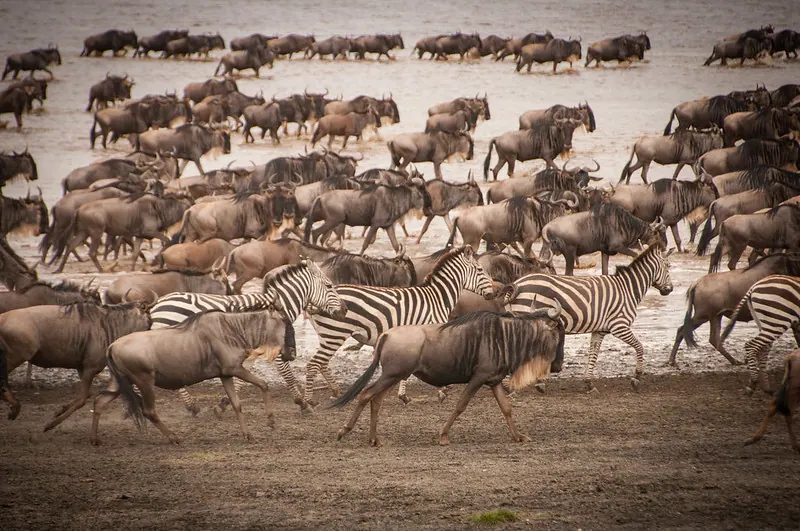

 WhatsApp